Monday, Sep 28, 2026
1 SpaceX Starship Reaches Orbit for First Time Despite Engine Failure, Deploys 26 Starlink Satellites↩︎SPCX 💻 Tech Sep 24, 5:08 PM EDT 161/65 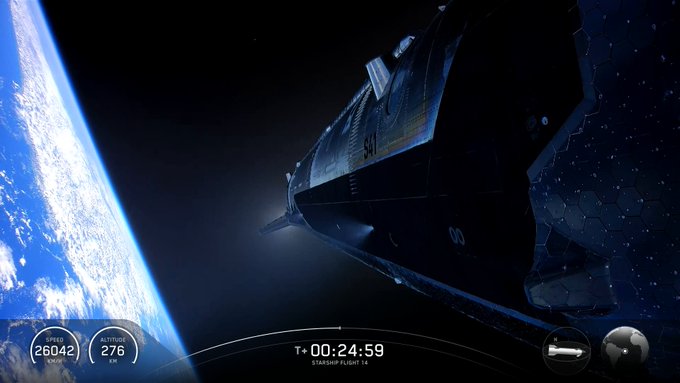 ▶
▶
▶An engine went out during the ascent of Starship's 14th flight and left the ship on a passively safe suborbital trajectory while teams checked systems. SpaceX at first said Starship would not enter orbit, then proceeded with an insertion burn from a single Raptor engine that put the rocket into a roughly 275 km orbit of Earth for the first time. Starship went on to deploy 26 Starlink V3 satellites in a sequence that took about 30 minutes, the program's first revenue-generating payload. The flight was Starship's first orbital attempt after 13 suborbital test flights.
SpaceX shares fell to a premarket low after the engine failure and erased the losses once the mission was declared go for orbit. The payload adds up to 26 Tbps of capacity to the Starlink constellation, with each V3 satellite providing up to 1 Tbps of downlink. A single flight can add roughly the capacity of ten Falcon 9 Starlink missions, which could cut the cost per Tbps in orbit by about 10x. SpaceX is counting on Starship to scale Starlink, its largest and only profitable segment as of the second quarter.
The mission is expected to complete about six orbits before splashing down in the Pacific off the coast of Chile after nearly 10 hours. The flight follows more than $15 billion in development costs, per the S-1, and almost 15 years of research. Starship reached orbit 18 years after SpaceX became the first private company to put a liquid-fueled rocket into orbit with Falcon 1. Future Starship missions could carry up to 60 V3 satellites at a time. Liftoff came 66 days after the previous Starship flight, a slightly slower cadence than the 63 days between Flights 12 and 13.